

www.leonita.co.za
Understanding Estate Liquidity
When planning what happens to your estate after you pass away, it is easy to get caught up in who gets the family home, who inherits the vintage watch, and how to take care of the kids.

But there is a silent, invisible dealbreaker in South African estate planning that can completely derail your best intentions: estate liquidity. In simple terms, liquidity is the amount of actual cash or cash-equivalents available in your deceased estate. Before your family can inherit a single cent or a piece of land, your estate has to clear its own bills. If there is no cash to pay those bills, your estate is considered "illiquid." That is when things can get incredibly stressful for your loved ones.

The Hidden Trap: Control vs. Forced Sales Liquidity is the dividing line between your assets being handled on your terms, or being handled entirely on the executor’s terms. If your estate has enough cash: The executor pays off your debts, settles the taxes, hands over the keys to your heirs, and wraps up the process smoothly.

If your estate is short on cash: The executor is legally required to find that cash somewhere. This usually means they will be forced to launch a “sale” of your hard-earned assets—like selling the family home, investment properties, or business shares—often for far less than they are actually worth, just to clear the debt. 
Read More
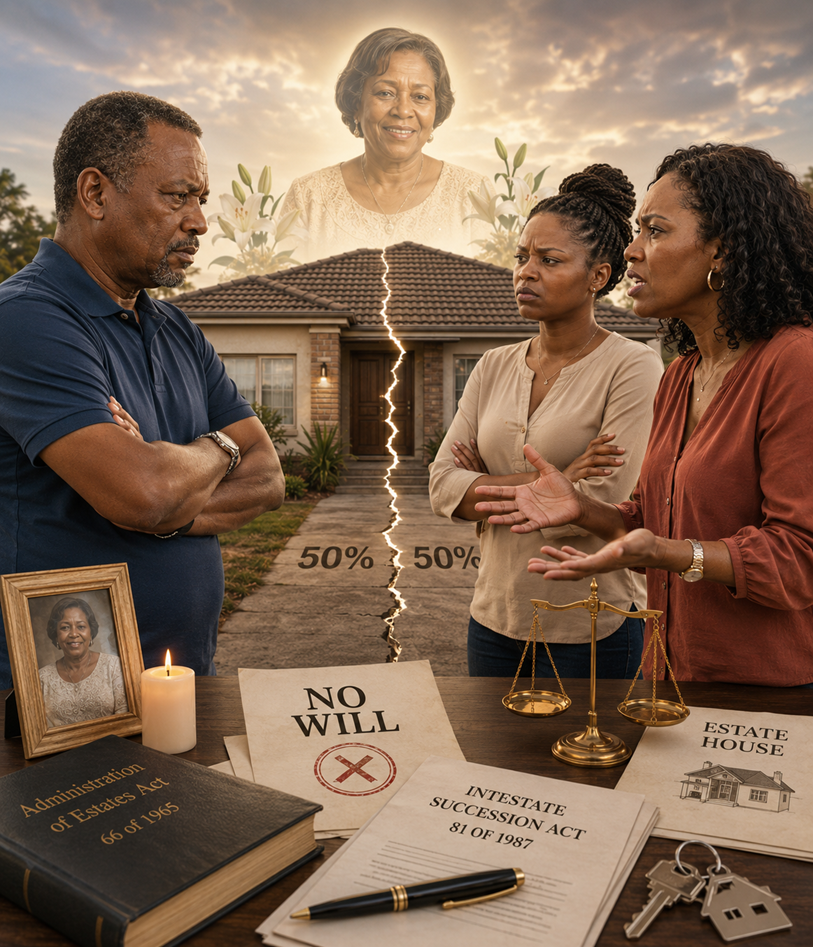
Property Dispute after Divorce and there are no Wills
Scenario: A consultation was held with the eldest daughter regarding her deceased mother’s estate. The daughter approached me for legal guidance regarding a family property dispute. The Master of the High Court has formally appointed her as the Executor of her late mother’s estate.
As the Master-appointed Executor, the eldest daughter holds the sole legal authority to control and protect her late mother’s 50% share of the asset. The father retains his original 50% share.
The daughters have a right of occupation and cannot be legally evicted by their father. Under South African law, the father’s claim of sole ownership is legally incorrect. Because the couple was divorced, any automatic spousal inheritance rights ended. Because the mother died intestate (without a will), her 50% co-ownership share of the property belongs entirely to her two daughters.
The father cannot sell the house or transfer it into his name without the daughters’ consent. The Deeds Office requires the signature of the deceased mother’s Executor to move her 50% share.
Read More
www.leonita.co.za