

Can my father evict me from my late mother’s house?

Property rights after divorce and intestate death

Property rights after divorce and intestate death

Scenario: A consultation was held with the eldest daughter regarding her deceased mother’s estate. The daughter approached me for legal guidance regarding a family property dispute. The Master of the High Court has formally appointed her as the Executor of her late mother’s estate.

As the Master-appointed Executor, the eldest daughter holds the sole legal authority to control and protect her late mother’s 50% share of the asset. The father retains his original 50% share. The daughters have a right of occupation and cannot be legally evicted by their father.

Under South African law, the father’s claim of sole ownership is legally incorrect. Because the couple was divorced, any automatic spousal inheritance rights ended.

Because the mother died intestate (without a will), her 50% co-ownership share of the property belongs entirely to her two daughters.

Breakdown of property rights

• The Husband’s Share: The ex-husband retains his original 50% co-ownership share. He cannot claim his deceased ex-wife’s half.

• The Wife’s Share: Because she died without a will (intestate), her 50% share is distributed according to the Intestate Succession Act 81 of 1987.

• The Children’s Inheritance: Under this law, the deceased’s estate is divided equally among her descendants. The two daughters inherit 25% each of the total property.

The ownership of the house is now legally split three ways:

Ex-Husband 50% (His original share)

Daughter 1 25% (Inherited from Mother)

Daughter 2 25% (Inherited from Mother)

The father cannot sell the house or transfer it into his name without the daughters’ consent. The Deeds Office requires the signature of the deceased mother’s Executor to move her 50% share.

Living arrangements and costs

Because all three parties are now legal co-owners, the living dynamic changes significantly:

• Right of Occupation: The father has a right to live there because he owns 50%.

The daughters also have an equal right to live there because they jointly own the other 50%.

The father cannot legally evict them.

• Splitting Household Expenses: Rates, taxes, water, electricity, and general maintenance should now be divided proportionally according to ownership (50% paid by the father, and 50% split between the daughters).

What must happen next

The executor/ daughter must approach a conveyancing attorney, who must formally transfer the mother’s 50% share to each daughter (25%) through the Deeds Office.

How to resolve the co-ownership

Once the Title Deed is updated, the daughters and the father must agree on one of three options:

• Buy-Out: The father buys the daughters’ 50% share, or the daughters buy out the father’s 50% share.

• Sell the Property: All parties agree to sell the house and split the money (50% to the father, 25% to each daughter).

• The Rental Alternative: If the daughters choose to move out in the future, the father must pay them a market-related monthly rent for utilising their 50% share of the property.

• Forced Sale (Actio Communi Dividundo): If living together becomes impossible and the father refuses to buy them out or sell, the daughters can hire an attorney to approach the High Court. The court will order the house to be sold on the open market, and the proceeds will be split (50% to the father, 25% to each daughter).

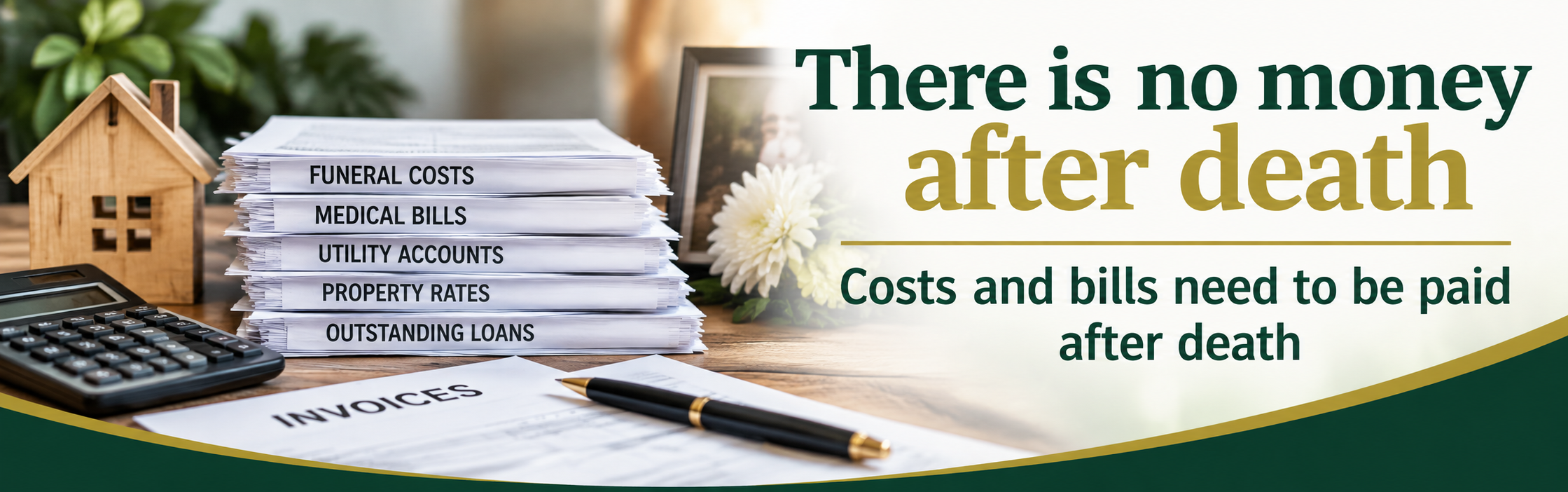
What must be paid after Death?

The silent dealbreaker in South African estate planning: liquidity

The silent dealbreaker in South African estate planning: liquidity

When planning what happens to your estate after you pass away, it is easy to get caught up in who gets the family home, who inherits the vintage watch, and how to take care of the kids.

But there is a silent, invisible dealbreaker in South African estate planning that can completely derail your best intentions: estate liquidity. In simple terms, liquidity is the amount of actual cash or cash equivalents available in your deceased estate. Before your family can inherit a single cent or a piece of land, your estate has to clear its own bills. If there is no cash to pay those bills, your estate is considered "illiquid." That is when things can get incredibly stressful for your loved ones.

The hidden trap: control vs forced sales

Liquidity is the dividing line between your assets being handled on your terms or being handled entirely on the executor’s terms.

If your estate has enough cash: the executor pays off your debts, settles the taxes, hands over the keys to your heirs, and wraps up the process smoothly.

If your estate is short on cash: the executor is legally required to find that cash somewhere. This usually means they will be forced to launch a “sale” of your hard-earned assets—like selling the family home, investment properties, or business shares—often for far less than they are actually worth, just to clear the debt.

Beware the "free will" marketing pitch

We have all seen Facebook posts or companies offering to draft a "free will." In the financial world, nothing is truly free. These companies offer free wills to get them appointed as the executor of your estate, because that is where the real money is. Lately, corporate executors and this “Facebook executors” have started using a new tactic where they look at your estate, tell you that you have a "liquidity gap," and then sell you a life insurance policy specifically structured to pay out directly to them for their executor fees.

While that sounds great in theory, it is often a trap designed with their interests in mind, not your family’s:

You lose your fee bargaining power: when a corporate or “Facebook” executor knows there is immediate, easy cash sitting in the estate account, they have zero incentive to discount their fees. Your family loses all leverage to negotiate a lower executor's fee because the cash is already sitting right there for the taking.

Good estate planning can create liquidity without unnecessarily padding the pockets of “greedy” executors or inflating your tax bill.

What actually counts as a "liquid asset"?

Liquid assets are things the executor can use almost instantly to pay the bills. In South Africa, these include:

• Physical cash and money market funds.

• Money sitting in your personal transactional and savings bank accounts.

• Life insurance policies where the estate is named as the beneficiary (which, as we just noted, gives the executor instant cash but comes with major tax strings attached).

The massive bills your estate must pay first

Before your heirs receive a single asset, your executor has a legal checklist of cash obligations that must be paid upfront.

1. All debts and liabilities

Your personal debts do not vanish when you die. Your estate must settle everything, from credit cards and personal loans to retail store accounts. The biggest issue here is almost always the property bond. Many people assume that if they own a house jointly with a spouse, the surviving spouse just takes over the bond. This is a myth. The bank is under no legal obligation to accept the surviving spouse as the sole bondholder. The survivor must completely re-qualify for the bond under the strict rules of the National Credit Act. If they do not meet the income criteria on their own, the bank will demand that the remaining balance of the bond be paid off immediately. If there is no life insurance or cash to do this, the house will have to be sold.

2. Immediate funeral costs

Funeral parlours require upfront payment before finalizing arrangements. While Section 10 of our Constitution guarantees the right to human dignity—which extends to a dignified burial—the practical reality is a grey area. If a family cannot pay upfront, parlours can charge daily storage and holding fees. This is why having a standalone funeral policy that pays out to a specific family member (not the estate) within 24 hours is vital.

3. The executor’s fee

By law (the Administration of Estates Act), an executor can charge up to 3.5% of the gross value of your estate, plus 15% VAT. Remember, this 3.5% is the maximum limit, not a fixed law. It is entirely negotiable when you are alive and planning your estate.

4. General administration costs

Winding up an estate comes with a mountain of smaller, mandatory legal fees. Your estate will need cash to cover Master of the High Court fees, sworn appraisal costs to value your assets, advertising fees to alert creditors in the newspapers, and conveyancing attorney fees to transfer title deeds into your heirs' names.

5. Estate duty (the death tax)

Estate duty is South Africa's inheritance tax, regulated by the Estate Duty Act: it is charged at 20% on the dutiable value of your estate up to R30 million. It jumps to 25% on any amount above R30 million. Everyone gets a standard R3.5 million tax-free abatement. If you leave everything to a surviving spouse, Section 4(q) exempts those assets entirely from estate duty. This means if you leave your whole estate to your spouse, and they pass away later, they can use your unused rebate—giving them a combined R7 million tax-free allowances.

6. Capital gains tax (cgt) on "deemed disposal"

The day you die, the law treats it as if you sold everything you own to a fictional buyer at market value right before your death. Any growth on your assets is taxed at your individual marginal rate, using an 80% inclusion rate. You do get a special R300,000 death exclusion for capital gains in the year you pass away, alongside the normal R40,000 annual exclusion. The spousal exception: anything you leave directly to a surviving spouse does not trigger this tax at death. The assets simply roll over to them at their original "base cost."

The legal pecking order: who gets paid first?

The legal pecking order: who gets paid first?

If your estate runs into a cash crunch, the executor cannot just pay whoever scream the loudest. They must strictly follow the statutory sequence of payment distribution laid out by South African law. Here is exactly who stands in line, from first to last:

1. Funeral costs

Paid first as a matter of public policy and basic humanity. Reasonable burial expenses take absolute priority over any commercial business or bank.

2. Executor fees and administration costs

The executor holds a legal "lien" over your assets. This means they get first access to the cash to cover their 3.5% + VAT fee, Master’s fees, and transfer costs before settling any other debts.

3. Secured creditors

These are institutions that hold a specific asset as security for a loan. The classic example is a bank holding the mortgage bond over your house. If there is no outside cash (like a life policy) to clear the bond, the executor will have to sell that specific house to pay the bank.

4. Preferent creditors

These are creditors given legal priority by statute. In a deceased estate, the biggest “screamer” here is SARS. Any outstanding income tax, VAT, and estate duty must be paid before general creditors get a cent. Employee wage claims (if you ran a sole proprietorship business) or specific landlord claims also fall here.

5. Concurrent (unsecured) creditors

This is the general crowd—credit cards, retail store accounts, personal loans, and unpaid medical bills. They all rank equally (pari passu) and share whatever cash is left over on a pro-rata basis.

6. Heirs and legatees

Are at the absolute end of the line. Your loved ones only get what is left over after everyone else above has been paid in full. Within this group, legatees (people you left a specific item to, like "my gold watch") get their items first. Heirs (the residual beneficiaries who get "the rest of my estate") get whatever remains at the very end.

Last but important: the SARS compliance letter

Even if your estate has plenty of cash and the executor has paid off every single creditor, no inheritance can be handed over, and no property can change names, until SARS issues an official Deceased Estate Compliance Letter (tax clearance).

The Master of the High Court will completely block the final distribution of your estate until this letter is in hand.

Taking the time to build for you a good liquid estate plan now, is the only way to ensure your family is not left in a financial disaster for months—or even years—while waiting for tax clearance.

How to Calculate a Child’s Share

How to Calculate a Child's Share

If you pass away without leaving a valid Will, your estate will devolve strictly in terms of the rules of intestate succession, as stipulated in the provisions of the Intestate Succession Act (Act 81 of 1987).

In the case of a marriage in community of property, one half of the estate automatically belongs to the surviving spouse by virtue of the matrimonial regime. Although it forms part of the joint estate, this half-share remains the property of the surviving spouse and will not devolve according to the rules of intestate succession.

If the deceased leaves behind a spouse and children (including legally adopted children), both the spouse and the children will inherit a portion. Under the Act, the surviving spouse is legally entitled to receive either a fixed statutory amount of R250,000 or a child’s share, whichever amount is higher.

How to Calculate a Child's Share

To determine the value of a child’s share, you must divide the total value of the deceased person's estate by the number of children plus one (representing the surviving spouse).

Consider these two practical legal scenarios:

  • Scenario A (Out of Community of Property): A deceased wife leaves an estate valued at R3 million, survived by her husband and two children. The estate value is divided by three (the husband plus two children). Each heir receives R1 million. Because R1 million is greater than the statutory R250,000 baseline, the calculated child’s share applies.
  • Scenario B (In Community of Property): A couple is married in community of property with a combined joint estate valued at R1.4 million. Upon the wife's passing, she leaves behind her husband and three children. The calculation follows two specific steps:
    1. The surviving spouse immediately receives his half-share of the joint estate, which amounts to R700,000.
    2. The remaining R700,000 forms the deceased's estate and must be divided by four (the surviving spouse plus three children), resulting in a raw calculation of R175,000 per dependent.
    Because the raw calculation of R175,000 falls below the legal baseline, the surviving spouse is entitled to the higher statutory child's share of R250,000. The remaining balance of R450,000 is then split equally among the three children, meaning each child will receive R150,000.

What is a Section 18(3) Estate?

Section 18(3) Estates

In South African law, a Section 18(3) estate is a deceased estate with a total gross asset value of R250,000 or less.

South African law separates deceased estates into two categories based on their financial value: Section 18(3) Estates (small estates) and Full Estates (large estates). The government created this division to make winding up smaller estates faster, cheaper, and less complicated for grieving families.

Why the Law Separates the Estates

The Administration of Estates Act 66 of 1965 separates these estates for several practical reasons:

  • To Lower Financial Costs: Winding up a full estate requires legal notices and complex accounting, which can cost thousands of Rands. For a smaller estate, these costs could completely consume the inheritance. A Section 18(3) process eliminates advertisement fees and formal audit fees.
  • To Speed Up the Process: A full estate takes a long time because the law requires waiting periods for creditors to come forward. By bypassing these steps, a Section 18(3) estate allows heirs to access funds and transfer property much faster.
  • To Simplify the Work: Instead of hiring expensive attorneys to draft formal legal accounts, a Master’s Representative can usually handle the paperwork independently.
Main Duties of a Master's Representative

Their main duties are simple:

  • List the deceased person’s property.
  • Pay any outstanding debts.
  • Distribute what is left to the rightful heirs.

REGULAR REVIEW YOUR WILL

One of the most important documents you will ever sign is your will and will need your regular attention.

Any change in your personal circumstances can necessitate a review of your will, specifically a change to your marital status. When you divorce your spouse, you must update your will.

In terms of Section 2B of the Wills Act, you are provided with a period of three months from the date of your divorce to update your will. Should you pass away after three months of your divorce without updating your will, it will be assumed that you intended your ex-spouse to inherit as per the dictates of your will.

Same with your child’s guardian, who will exercise full parental rights and responsibilities and will be required to administer any property inherited by your minor child until they reach age 18. The guardian will be required to make all decisions regarding your child’s schooling, extra-mural activities, religious instruction, and assist or represent your minor child in contractual and/or legal matters until they reach maturity. Some parents nominate the grand parents as guardians of their minor children. You must regular assess their current health and whether they are physically capable of taking care of your children should you pass away. You may consider to nominate an alternative guardian in your will to provide for the eventuality that your parents are not capable to act as guardians. Same when you nominated family who emigrated to another country and therefore cannot take up the role as guardian. When you have minor children, this is very important to take into account when you review your will.

When it comes to your executor, make sure the firm or company you nominated still exist. This can become a problem if your family are unable to identify or locate your executor. If you have nominated a family member as executor, make sure that there is still a good bond between you and whether they are still the appropriate person to act as executor. When your nominated beneficiaries die, it is essential to review your will. As per the stirpes clause, when a beneficiary dies before you, that beneficiary’s share of the inheritance will pass to their heirs.

Relationships change over time and the effects of the per stirpes clause may not be in line with your intentions. If you have made special bequests in your will, it may be worth reviewing them. You may have bequeathed a fixed amount to a specific legatee, which is now outdated in relation to your current financial position.

Also make sure that your legatees are still alive and that there are not any other person to whom you would like to make a special bequest. VERY IMPORTANT is that your estate is sufficiently liquid to honour your bequests, as it will have an impact on your heirs’ inheritance.

AN IMPORTANT REQUIREMENT IS THAT YOUR WILL MUST BE VALID. Your executor must obtain an original signed copy of your will. If you only have a copy, consider drafting a new will. Ensure that your original will is stored in a safe place and that your executor know where to find your original will.

What happen to my Bitcoin when I Passed Away ?

Bitcoin is essentially a digital payment network where Bitcoin currency is stored and transferred. A Bitcoin is a form of digital token that you can send or receive electronically and the value of a Bitcoin also changes in much the same way that the value of stocks change based on bidding. Bitcoins are protected by powerful cryptography which makes it a secure way to store your wealth, but it also creates the risk that when you die, it will be out of reach for your heirs. Bitcoins are stored in a virtual wallet which uses a string of random characters called a “public key”. The public key is visible to anyone as an address for sending and receiving the cryptocurrency. A separate “private key” however allows the owner access to the wallet’s contents.

The Private Key Inheritance Hurdle

This means that when you die, your heirs may discover your Bitcoin wallet, but will be unable to gain access thereto without the private key. The easiest way to ensure that your Bitcoins can be transferred to your heirs is to ensure that someone has a copy of the private key by writing it down, storing it on a memory drive or entrusting it with a company or a trusted financial advisor or attorney who can give it to your family after your death. It is also a good idea to bequeath your Bitcoins formally in your will and identify who has a copy of the private key.

Important Note: Although it won’t form part of the physical assets of your estate to be administered, this will help ensure that there is no uncertainty as to whom you wanted to gain access to your wallet after your death.

GUARDIANS FOR CHILDREN

If you have minor children, it is crucial to nominate a guardian in your will. This person will care for your child if you pass away. The appointment process depends entirely on your current family structure:

  • Natural Co-Guardianship: If both parents are alive, your child has two natural guardians. Your court-appointed guardian only steps in if both parents die simultaneously.
  • Sole Guardianship: If you are the sole guardian, your nominated guardian assumes immediate responsibility upon your death.

Rights and Responsibilities Under the Children’s Act

According to the Children’s Act (38 of 2005), a nominated guardian who accepts the role acquires full parental rights and responsibilities. When choosing a guardian, carefully consider their:

  • Cultural background and personal value system
  • Religious beliefs
  • Geographical location
  • Financial stability

The legal guardian will manage your child's schooling, extra-mural activities, and vocational guidance. They will also administer inherited property and represent the minor in legal and contractual matters until they turn 18.

Tip: Always appoint an alternative guardian in your will in case your primary choice is unable or unwilling to take on the role.

Contractual Capacity & The Guardian’s Fund Pitfall

Children under 18 lack contractual capacity and cannot directly inherit. This creates significant structural challenges:

  • Cash inheritances: Paid into the state-run Guardian’s Fund, which administers the money until the child reaches the age of majority.
  • Fixed property: Must be administered by the legal guardian until the child turns 18.

The Problem: Relying on state funds or leaving complex property assets to individuals can lead to severe bureaucratic delays and financial strain.

The Strategic Alternative: A Testamentary Trust

You can bypass these challenges by creating a testamentary trust within your will. By naming the trust as the beneficiary of the assets meant for your minor children, you ensure that:

  • Assets transfer directly to the trust upon your passing.
  • Your children's inheritance remains protected and professionally managed.
  • Funds are readily accessible for their needs, completely avoiding government red tape.