

The silent dealbreaker in South African estate planning: liquidity
When planning what happens to your estate after you pass away, it is easy to get caught up in who gets the family home, who inherits the vintage watch, and how to take care of the kids.
But there is a silent, invisible dealbreaker in South African estate planning that can completely derail your best intentions: estate liquidity. In simple terms, liquidity is the amount of actual cash or cash equivalents available in your deceased estate. Before your family can inherit a single cent or a piece of land, your estate has to clear its own bills. If there is no cash to pay those bills, your estate is considered "illiquid." That is when things can get incredibly stressful for your loved ones.
The hidden trap: control vs forced sales
Liquidity is the dividing line between your assets being handled on your terms or being handled entirely on the executor’s terms.
If your estate has enough cash: the executor pays off your debts, settles the taxes, hands over the keys to your heirs, and wraps up the process smoothly.
If your estate is short on cash: the executor is legally required to find that cash somewhere. This usually means they will be forced to launch a “sale” of your hard-earned assets—like selling the family home, investment properties, or business shares—often for far less than they are actually worth, just to clear the debt.
Beware the "free will" marketing pitch
We have all seen Facebook posts or companies offering to draft a "free will." In the financial world, nothing is truly free. These companies offer free wills to get them appointed as the executor of your estate, because that is where the real money is. Lately, corporate executors and this “Facebook executors” have started using a new tactic where they look at your estate, tell you that you have a "liquidity gap," and then sell you a life insurance policy specifically structured to pay out directly to them for their executor fees.
While that sounds great in theory, it is often a trap designed with their interests in mind, not your family’s:
You lose your fee bargaining power: when a corporate or “Facebook” executor knows there is immediate, easy cash sitting in the estate account, they have zero incentive to discount their fees. Your family loses all leverage to negotiate a lower executor's fee because the cash is already sitting right there for the taking.
Good estate planning can create liquidity without unnecessarily padding the pockets of “greedy” executors or inflating your tax bill.
What actually counts as a "liquid asset"?
Liquid assets are things the executor can use almost instantly to pay the bills. In South Africa, these include:
• Physical cash and money market funds.
• Money sitting in your personal transactional and savings bank accounts.
• Life insurance policies where the estate is named as the beneficiary (which, as we just noted, gives the executor instant cash but comes with major tax strings attached).
The massive bills your estate must pay first
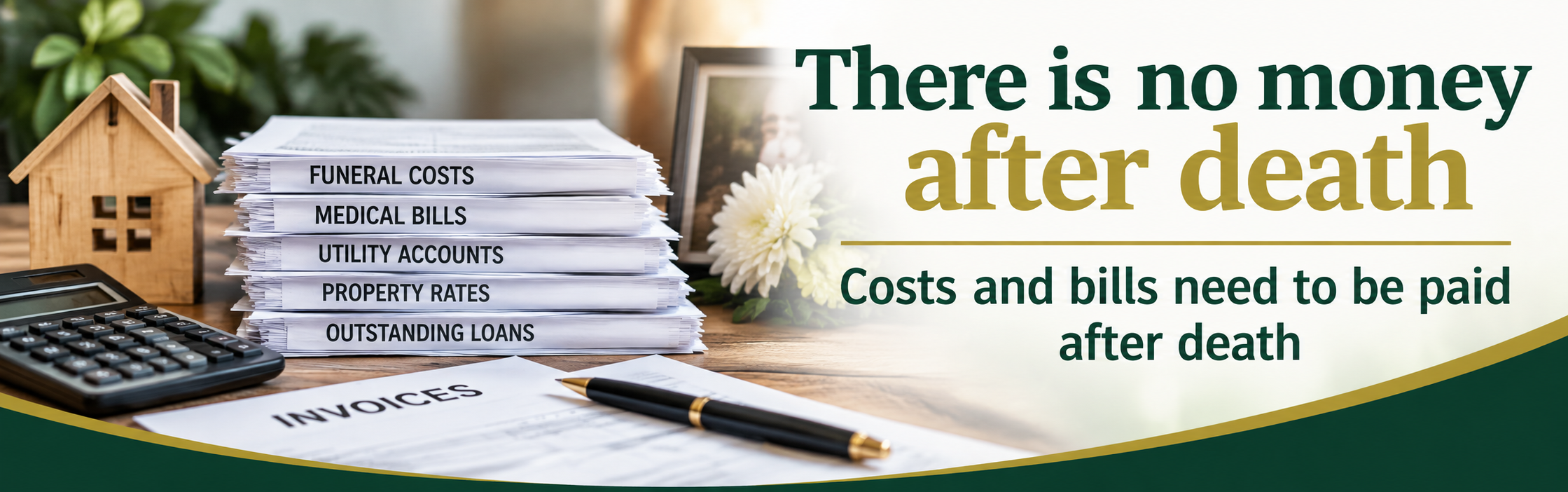
Before your heirs receive a single asset, your executor has a legal checklist of cash obligations that must be paid upfront.
1. All debts and liabilities
Your personal debts do not vanish when you die. Your estate must settle everything, from credit cards and personal loans to retail store accounts. The biggest issue here is almost always the property bond. Many people assume that if they own a house jointly with a spouse, the surviving spouse just takes over the bond. This is a myth. The bank is under no legal obligation to accept the surviving spouse as the sole bondholder. The survivor must completely re-qualify for the bond under the strict rules of the National Credit Act. If they do not meet the income criteria on their own, the bank will demand that the remaining balance of the bond be paid off immediately. If there is no life insurance or cash to do this, the house will have to be sold.
2. Immediate funeral costs
Funeral parlours require upfront payment before finalizing arrangements. While Section 10 of our Constitution guarantees the right to human dignity—which extends to a dignified burial—the practical reality is a grey area. If a family cannot pay upfront, parlours can charge daily storage and holding fees. This is why having a standalone funeral policy that pays out to a specific family member (not the estate) within 24 hours is vital.
3. The executor’s fee
By law (the Administration of Estates Act), an executor can charge up to 3.5% of the gross value of your estate, plus 15% VAT. Remember, this 3.5% is the maximum limit, not a fixed law. It is entirely negotiable when you are alive and planning your estate.
4. General administration costs
Winding up an estate comes with a mountain of smaller, mandatory legal fees. Your estate will need cash to cover Master of the High Court fees, sworn appraisal costs to value your assets, advertising fees to alert creditors in the newspapers, and conveyancing attorney fees to transfer title deeds into your heirs' names.
5. Estate duty (the death tax)
Estate duty is South Africa's inheritance tax, regulated by the Estate Duty Act: it is charged at 20% on the dutiable value of your estate up to R30 million. It jumps to 25% on any amount above R30 million. Everyone gets a standard R3.5 million tax-free abatement. If you leave everything to a surviving spouse, Section 4(q) exempts those assets entirely from estate duty. This means if you leave your whole estate to your spouse, and they pass away later, they can use your unused rebate—giving them a combined R7 million tax-free allowances.
6. Capital gains tax (cgt) on "deemed disposal"
The day you die, the law treats it as if you sold everything you own to a fictional buyer at market value right before your death. Any growth on your assets is taxed at your individual marginal rate, using an 80% inclusion rate. You do get a special R300,000 death exclusion for capital gains in the year you pass away, alongside the normal R40,000 annual exclusion. The spousal exception: anything you leave directly to a surviving spouse does not trigger this tax at death. The assets simply roll over to them at their original "base cost."
The legal pecking order: who gets paid first?
If your estate runs into a cash crunch, the executor cannot just pay whoever scream the loudest. They must strictly follow the statutory sequence of payment distribution laid out by South African law. Here is exactly who stands in line, from first to last:
1. Funeral costs
Paid first as a matter of public policy and basic humanity. Reasonable burial expenses take absolute priority over any commercial business or bank.
2. Executor fees and administration costs
The executor holds a legal "lien" over your assets. This means they get first access to the cash to cover their 3.5% + VAT fee, Master’s fees, and transfer costs before settling any other debts.
3. Secured creditors
These are institutions that hold a specific asset as security for a loan. The classic example is a bank holding the mortgage bond over your house. If there is no outside cash (like a life policy) to clear the bond, the executor will have to sell that specific house to pay the bank.
4. Preferent creditors
These are creditors given legal priority by statute. In a deceased estate, the biggest “screamer” here is SARS. Any outstanding income tax, VAT, and estate duty must be paid before general creditors get a cent. Employee wage claims (if you ran a sole proprietorship business) or specific landlord claims also fall here.
5. Concurrent (unsecured) creditors
This is the general crowd—credit cards, retail store accounts, personal loans, and unpaid medical bills. They all rank equally (pari passu) and share whatever cash is left over on a pro-rata basis.
6. Heirs and legatees
Are at the absolute end of the line. Your loved ones only get what is left over after everyone else above has been paid in full. Within this group, legatees (people you left a specific item to, like "my gold watch") get their items first. Heirs (the residual beneficiaries who get "the rest of my estate") get whatever remains at the very end.
Last but important: the SARS compliance letter
Even if your estate has plenty of cash and the executor has paid off every single creditor, no inheritance can be handed over, and no property can change names, until SARS issues an official Deceased Estate Compliance Letter (tax clearance).
The Master of the High Court will completely block the final distribution of your estate until this letter is in hand.
Taking the time to build for you a good liquid estate plan now, is the only way to ensure your family is not left in a financial disaster for months—or even years—while waiting for tax clearance.